
Anamorphic Lenses Explained: 1.33x vs 1.5x vs 1.8x vs 2x
Anamorphic lenses have been around for a very long time, but lately they seem to be everywhere. Independent filmmakers are shooting anamorphic. Commercials are shooting anamorphic. YouTube filmmakers are shooting anamorphic. And suddenly, affordable anamorphic lenses are coming from companies that didn’t even exist in the conversation a few years ago.
So what’s going on? Anamorphic is cool again — and unlike some filmmaking trends, this one actually has some pretty good reasons behind it.
What Is an Anamorphic Lens?
A traditional spherical lens records an image more or less as you see it. An anamorphic lens does something different: it squeezes the image horizontally before it reaches the camera’s sensor. Imagine taking a really wide photograph and squeezing it from the sides until it fits inside a smaller box — that’s essentially what’s happening. Then, in post-production (or with the camera’s monitoring system), the image is stretched back out to its proper proportions. That’s where the magic happens.
Anamorphic lenses can give you:
- Wider cinematic images
- Distinctive oval-shaped bokeh
- Horizontal lens flares
- Characteristic falloff
- Unique distortion
- A different rendering of faces and backgrounds
- The classic “cinema” look associated with anamorphic photography
Some of these characteristics are subtle, and some are very obvious — that’s part of the fun.
What Does 2x Anamorphic Actually Mean?
This is where things start getting confusing. You’ll see lenses advertised as 1.33x, 1.5x, 1.6x, 1.8x, or 2x. The number represents the amount of horizontal compression: a 2x anamorphic lens squeezes the image horizontally by a factor of two, a 1.5x lens by 1.5 times, and a 1.33x lens by 1.33 times.
So if you’re looking at footage straight from a 2x anamorphic lens without de-squeezing it, people will look extremely skinny. That’s occasionally entertaining, but probably not the look you’re going for.
Why Are 1.5x Lenses So Popular Right Now?
Historically, 2x anamorphic was very popular because it produces a strong, unmistakable anamorphic character. But it also comes with practical challenges — depending on the sensor and recording format, a 2x squeeze can produce an extremely wide image once de-squeezed. That’s fantastic if you’re deliberately building a traditional CinemaScope-style image, but it can be awkward for modern digital cameras and modern delivery formats.
That’s where 1.5x anamorphic has become really interesting. You get a noticeable anamorphic character without quite as extreme a squeeze, and a growing number of relatively affordable lenses now offer a 1.5x squeeze. That has opened anamorphic up to filmmakers who don’t have a Hollywood lens budget.
Anamorphic Lenses Getting Attention Right Now
More anamorphic options than ever now exist, ranging from relatively affordable indie glass to extremely high-end cinema lenses. A few names you’ll see frequently include Atlas Mercury, ARRI Master Anamorphic, and Cooke Anamorphic/i, alongside newer offerings from companies like Sirui, Blazar, and DZOFILM.
The Atlas Mercury series is particularly interesting because it combines a 1.5x squeeze with full-frame coverage in a much more compact package than traditional large-format anamorphics. And then there’s one newer option that we’re particularly excited about.
Our New DZOFILM Arcana Anamorphic Lenses
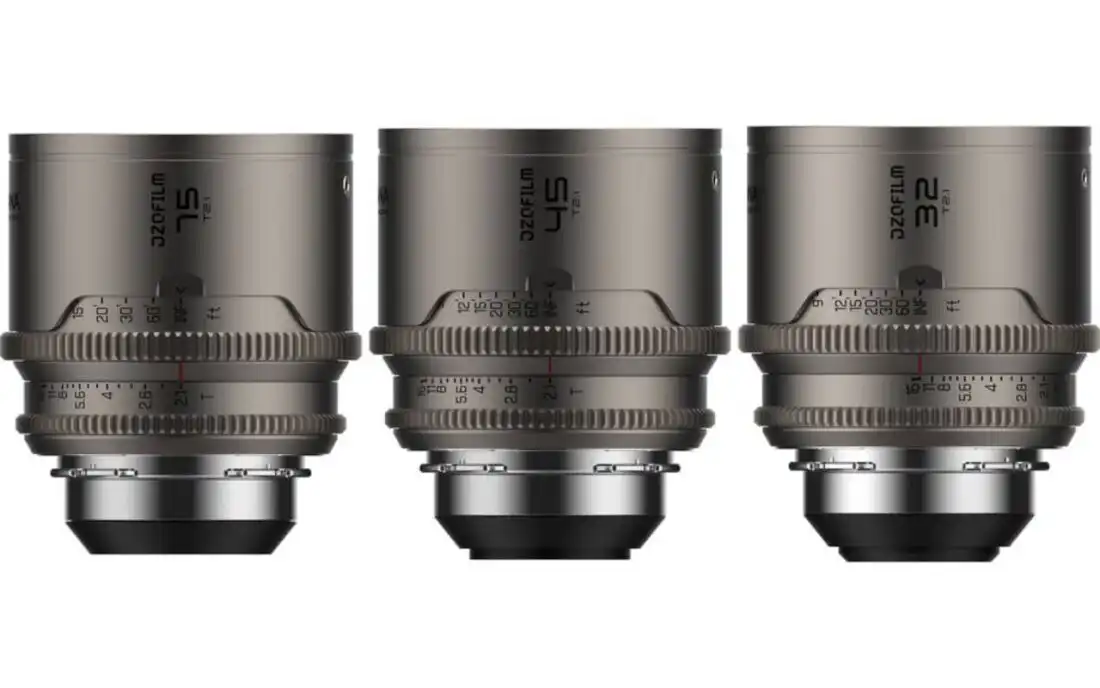
We’ve recently added the DZOFILM Arcana anamorphic lenses to our rental lineup, and honestly, these are some of the most interesting anamorphics we’ve seen at this price and size.
The Arcana series is a 1.5x full-frame hybrid anamorphic set available in 32mm, 45mm, and 75mm, all at a constant T2.1. They’re PL-mount and cover a full-frame/VV image circle. Here’s what caught our attention: DZOFILM designed them to deliver some of the visual characteristics normally associated with 2x anamorphic lenses while keeping the practical advantages of a 1.5x lens.
The Arcana uses a hybrid design combining a front cylindrical anamorphic element with an oval aperture. DZOFILM says this produces the characteristic “waterfall” bokeh associated with 2x anamorphic glass, while maintaining a 1.5x squeeze — a pretty interesting combination.
Arcana specs at a glance
| Arcana Specs at a Glance | 32mm | 45mm | 75mm |
|---|---|---|---|
| Squeeze | 1.5x | 1.5x | 1.5x |
| Aperture | T2.1–T16 | T2.1–T16 | T2.1–T16 |
| Coverage | Full Frame | Full Frame | Full Frame |
| Minimum Focus | 0.48m / 1.6′ | 0.53m / 1.7′ | 0.78m / 2.6′ |
| Weight | 709g | 695g | 709g |
| Front Diameter | 80mm | 80mm | 80mm |
| Filter Thread | 77mm | 77mm | 77mm |
| Focus Rotation | 270° | 270° | 270° |
All three lenses are surprisingly compact — only about 80mm long and roughly 700g each — which makes them much more practical for handheld work, gimbals, and other situations where a giant anamorphic lens can become a serious workout. They also maintain a constant 1.5x squeeze from close focus to infinity, which helps reduce the face-widening “mumps” effect that can be an issue with some anamorphic designs.
And because the lenses share the same basic physical dimensions and front diameter, swapping between them is much easier on a production — no rebuilding the entire camera every time you change focal lengths. For an independent production, that’s a big deal.
Why Does Sensor Size Matter?
This is where things get really interesting. If you’re using a 2x anamorphic lens, you need to think about how much vertical sensor area you’re using. For example, a 2x anamorphic lens on a 16:9 sensor can produce an extremely wide final image once de-squeezed. That’s not necessarily bad, but you may end up cropping heavily to get the final aspect ratio you want — which is one reason dedicated anamorphic recording modes can be so useful.
4:3 and 6:5
Traditional anamorphic cinema often uses taller recording areas such as 4:3 or 6:5 before the image is de-squeezed. For example, a 2x squeeze applied to a 6:5 recording area produces approximately a 2.4:1 image after de-squeezing. Canon specifically provides 4:3 and 6:5 anamorphic recording options on the C500 Mark II when shooting RAW — a big deal for filmmakers who actually want to take advantage of a 2x anamorphic lens rather than simply putting one on a normal 16:9 recording mode.
And Then There’s Open Gate
This is one reason newer cameras are getting exciting for anamorphic shooters. Open Gate means you’re using a much larger portion of the sensor — often the full sensor area — instead of restricting yourself to a conventional 16:9 or 17:9 recording window. That gives you more vertical image information, which is extremely useful when you’re going to horizontally stretch the image later.
Canon’s C400, for example, has a full-frame 3:2 Open Gate mode specifically suited to full-frame anamorphic lenses, and the newer C50 also has a full-frame 3:2 mode. That’s a major reason Open Gate and anamorphic are suddenly being talked about together so much.
But here’s something important: you do not need Open Gate to shoot anamorphic. This is a common misconception — you can absolutely shoot anamorphic on cameras that don’t have Open Gate. You just need to understand what you’re recording and what your final aspect ratio will be.
What About Sony Cameras?
Sony has actually become much more anamorphic-friendly than many people realize. The FX3 supports anamorphic de-squeeze monitoring, with selectable ratios including 1.3x, 1.5x, 1.6x, and 2.0x. The FX6 also supports anamorphic de-squeeze display for 2.0x and 1.3x anamorphic lenses, and the FX9 supports de-squeeze display as well.
But there’s an important distinction: de-squeeze display isn’t the same as Open Gate recording. The camera can make the image look correct on your monitor without actually recording a taller sensor area. That’s still very useful — it means your focus puller, operator, and director aren’t staring at a bunch of skinny people on the monitor all day.
What About Canon?
Canon has been particularly friendly toward anamorphic workflows on its Cinema EOS cameras. The C500 Mark II is a great example — it supports anamorphic shooting and, with the appropriate RAW recording modes, provides 4:3 and 6:5 sensor options specifically suited to anamorphic lenses. The C400 goes even further with full-frame 3:2 Open Gate and built-in de-squeeze options, and the C50 also supports anamorphic de-squeeze.
The C80 also supports anamorphic de-squeeze, although its available ratios are more limited than some of the newer cameras. And the C70? It can absolutely be used with anamorphic lenses, but it doesn’t have the same Open Gate capability as the newer full-frame cameras.
Why the Sudden Anamorphic Boom?
Honestly, the lenses got cheaper, and there are more of them — that’s probably the biggest reason. For decades, anamorphic glass was something you associated with expensive cinema productions. Now there are companies making relatively affordable anamorphic lenses for Sony E, Canon RF, PL, and other mounts, and they’re actually pretty good. They won’t necessarily behave exactly like a vintage Panavision anamorphic lens that costs more than your house, but that’s also the point — you can now get a taste of the anamorphic look without selling a kidney.
Lenses like the Arcana are pushing that idea even further: full-frame coverage, T2.1, 1.5x squeeze, and a very compact package for a fraction of the size — and typically the cost — of traditional high-end anamorphic sets.
Don’t Buy an Anamorphic Lens Just Because It Looks Cool
This is where filmmakers sometimes get carried away. Anamorphic lenses can introduce:
- More complicated focusing
- Minimum-focus limitations
- Distortion
- Uneven sharpness
- More difficult lens matching
- More complicated framing
- More post-production considerations
- Additional weight
- More difficult gimbal balancing
And depending on the lens, autofocus may be limited or unavailable. So if you’re shooting a documentary where you have 30 seconds to grab an important moment, a complicated anamorphic setup may not be your best friend. If you’re shooting a narrative film where you control the environment, that’s a different story.
Anamorphic vs. Spherical: Which Is Better?
Neither. Spherical lenses are predictable, versatile, and often easier to use. Anamorphic lenses have character, and sometimes character is exactly what you’re looking for.
Personally, we think the recent popularity of anamorphic is a good thing — not because anamorphic is inherently better, but because filmmakers now have another creative tool that is actually accessible.
The Bottom Line
If you want a clean, predictable image, shoot spherical. If you want the classic wide cinematic look, oval bokeh, horizontal flares, and a little more personality, try anamorphic.
Just make sure you know what squeeze you’re buying, because 1.33x, 1.5x, 1.8x, and 2x lenses aren’t interchangeable just because they all have the word “anamorphic” on the box. Before you put one on your camera, check what your camera can actually record and display — because there’s a big difference between “this camera can use an anamorphic lens” and “this camera is actually designed to take advantage of one.”
That’s where things get interesting.