
Canon C70 vs C80: The Showdown
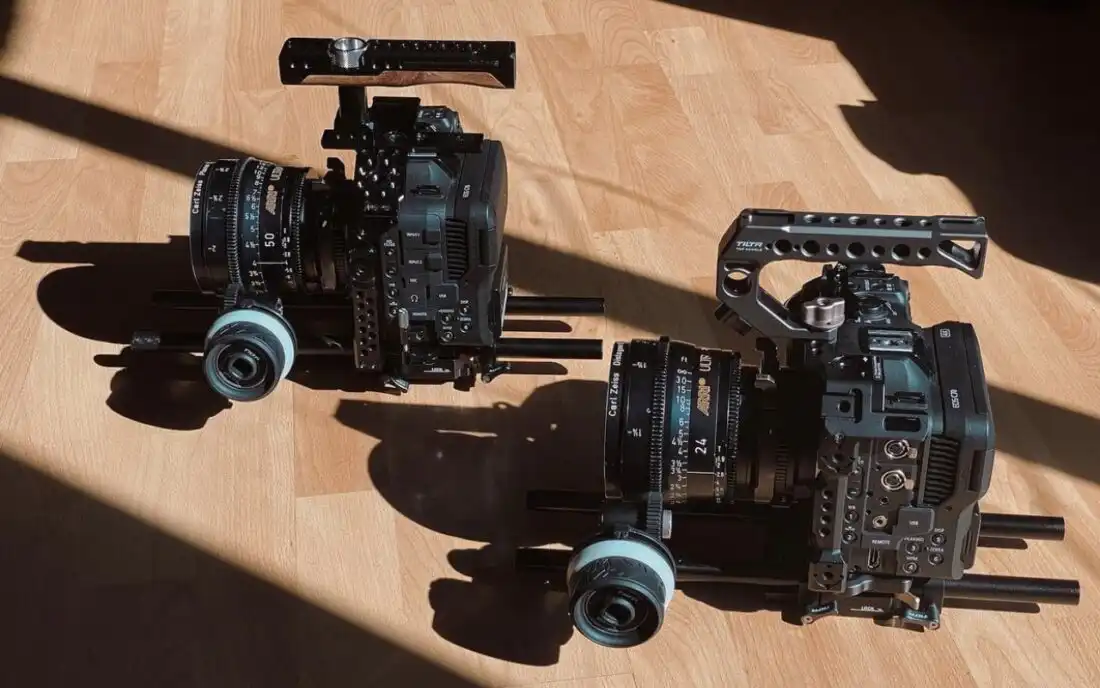
Canon’s C70 was already one of the most interesting compact cinema cameras on the market. Then Canon released the C80, and suddenly the question became Canon C70 vs C80. Is the C80 actually better, or is the C70 still the camera to use?
The short answer? The C80 is more advanced, but the C70 can still be more appealing. The specifications point one way, while the image itself pulls some shooters the other way. Here’s why.
Canon C70 vs C80: The Biggest Difference Is the Sensor
The C70 uses a Super 35 DGO sensor. The C80 uses a 6K full-frame back-illuminated stacked CMOS sensor. That gives the C80 a significant advantage in resolution and field-of-view flexibility.
Super 35 vs Full Frame
Super 35 and full frame both describe the physical size of a sensor. Super 35 takes its name from a motion picture film format, and full frame is the larger of the two.
Sensor size changes how much of the scene you capture through a given lens. Put the same lens on both cameras, and the full-frame C80 captures a wider view. The Super 35 C70 captures a tighter slice of that same scene. That’s the field-of-view side of the C80’s advantage.
What DGO, Back-Illuminated and Stacked Mean
DGO stands for Dual Gain Output. In plain terms, the sensor reads each image at two different gain levels at the same time and then combines them. Canon designed it that way to hold on to detail in both the bright and dark parts of a frame.
On the C80 side, back-illuminated means the sensor’s wiring sits behind its light-sensitive layer instead of in front of it. That way, the wiring blocks less of the incoming light. Stacked means the sensor’s circuitry sits in separate layers, a design aimed at reading each frame off the sensor faster.
Resolution: 6K vs 4K
The C80 can record 6K internally in Cinema RAW Light and offers 4K recording up to 120p. The C70, on the other hand, is fundamentally a 4K camera. In the Canon C70 vs C80 comparison, that resolution gap comes straight from the sensor.
Recording internally means the camera saves footage to its own media. Cinema RAW Light is Canon’s lighter-weight RAW format. RAW footage holds on to more of the sensor’s original information than a standard processed video file. That gives you more room to adjust color and exposure later in the edit.
Is 4K Enough?
For many productions, being a 4K camera isn’t a problem at all. 4K is still more than enough for most delivery formats, meaning the resolution and format your finished video goes out in.
But if you want the ability to crop, reframe or work from a 6K master, the C80 wins. Cropping and reframing mean adjusting the shot after the fact. For example, you might push in from a wide frame to a tighter one during the edit.
A 6K master gives you extra pixels to do that and still deliver a full 4K image. With a 4K camera, any push-in eats into the resolution you’re delivering.
SDI: One of My Favorite C80 Upgrades
This is one of my favorite C80 upgrades: 12G-SDI. The C70 relies on a single HDMI for video output. The C80, however, gives you professional SDI connectivity in addition to HDMI.
SDI stands for Serial Digital Interface, and it’s the video connection built for professional video work. The “12G” describes how much data it can carry, which lets it move high-resolution video down a single cable. SDI also uses a locking connector, so a cable can’t easily work itself loose in the middle of a take.
That makes a difference when you’re building a proper production rig. A rig is the camera plus everything mounted around it for a real shoot, such as monitors and wireless video.
Where SDI Makes a Difference on Set
Wireless video is a good example. A transmitter on the rig sends the camera’s image to screens elsewhere on set, so it needs a steady feed. A connector that locks in place is less likely to drop that feed while the camera moves.
On-camera monitoring and a director’s monitor depend on that feed too. On-camera monitoring means a screen mounted on the rig, where the camera operator checks framing and focus. A director’s monitor is a separate screen, so the director can watch each take as it happens.
Long cable runs are where SDI really shines. It carries a signal over much longer distances than HDMI, so a monitor far from the camera still gets a steady signal. Multi-camera environments raise the stakes further, since several cameras are feeding screens at once and every connection has to hold up. Put together, SDI is simply more appropriate for many professional production workflows.
Frame Rates: Where the Two Cameras Match
Frame rates are where the Canon C70 vs C80 comparison evens out. The C80 can shoot 4K at up to 120p, and the C70 can also shoot 4K at up to 120p.
That number describes how many frames the camera captures each second, and the “p” stands for progressive. Shooting at a high frame rate and playing the footage back at a normal speed is what creates smooth slow motion. Since both cameras top out at the same 4K frame rate, the 4K slow-motion ceiling is the same on either one.
So don’t buy the C80 thinking you’re getting dramatically higher 4K slow motion. The real advantages are elsewhere: the sensor, the resolution and the SDI connection.
But Here’s Where I Prefer the C70: The Image
This is completely subjective, but I find the C70 image has a certain character. It’s slightly softer, and it feels a little more organic. Fine edges and textures don’t jump off the screen quite as hard, so the picture feels a little less clinical.
The C80 is sharper, but not in a bad way. In fact, for many commercial applications, it’s exactly what you want.
When You Don’t Want Maximum Sharpness
But sometimes you don’t want maximum sharpness. Sometimes you want an image that feels a little more like cinema and a little less like “look at how many pixels I have.”
An image can be technically impressive and still seem like it’s showing off its resolution. A slightly softer rendering puts the feel of the shot ahead of the pixel count. That’s where the C70 remains interesting. It’s also the part of the Canon C70 vs C80 debate that no spec sheet can settle.
So Which One Should You Use?
The Canon C70 vs C80 decision really comes down to two things. The first is what your production needs from the camera, and the second is how you want the image to feel.
Choose the C70 If You Love Its Image
Choose the C70 if you love its image. If that softer, more organic character is the look you’re after, that alone is a good reason to pick it. It’s also the natural fit if you want Super 35.
The C70 makes sense, too, if you don’t need 6K and you don’t need SDI. If your projects deliver in 4K without much cropping or reframing, the extra resolution isn’t doing much for you. Likewise, if your monitoring setup stays simple, a single HDMI output may be all you need.
Choose the C80 If You Want Full Frame and 6K
When you weigh the Canon C70 vs C80 on specifications and connectivity, the C80 is the stronger pick. Choose the C80 if these sound like you:
- You want full frame.
- You want 6K.
- You want 12G-SDI.
- You want the newer autofocus system.
- You want a compact camera that can grow into a more serious production configuration.
That last point is where the SDI connection pays off. The C80 starts out as a compact camera, but you can build it into a full rig with wireless video, a director’s monitor and long cable runs.
My Verdict on the Canon C70 vs C80
If you’re buying purely based on specifications, the C80 wins, every time. It has the full-frame sensor, the 6K recording, the 12G-SDI connection and the newer autofocus system.
If you’re choosing based on image character and personal preference, that’s much closer. DPs, or directors of photography, are the people responsible for a production’s look. I wouldn’t be surprised if some of them continue choosing the C70 even after shooting the C80.
That’s because cameras aren’t spreadsheets. A spec sheet can tell you about resolution, frame rates and connections, but it can’t tell you how an image feels. Sometimes you simply like the way one looks, and that’s a perfectly valid reason.
Let’s Make Something
If you’re weighing cameras for an upcoming shoot, we’re happy to talk it through. We know the equipment we rent because we actually use it, and our camera and equipment rentals are prepped and ready to go before every rental. Need an operator or an assistant with the camera? We can provide experienced production crew, or handle the whole job through our video production team.
Whether your project needs creative development before the cameras roll or a single piece of gear on shoot day, our production services are built around your project, and our portfolio covers documentary, commercial and branded work. As a small, owner-led production company, we give you one point of contact from start to finish. Tell us about your shoot, get a quote or call 954-249-0702.