
Full Frame vs Super 35: Does It Actually Matter?
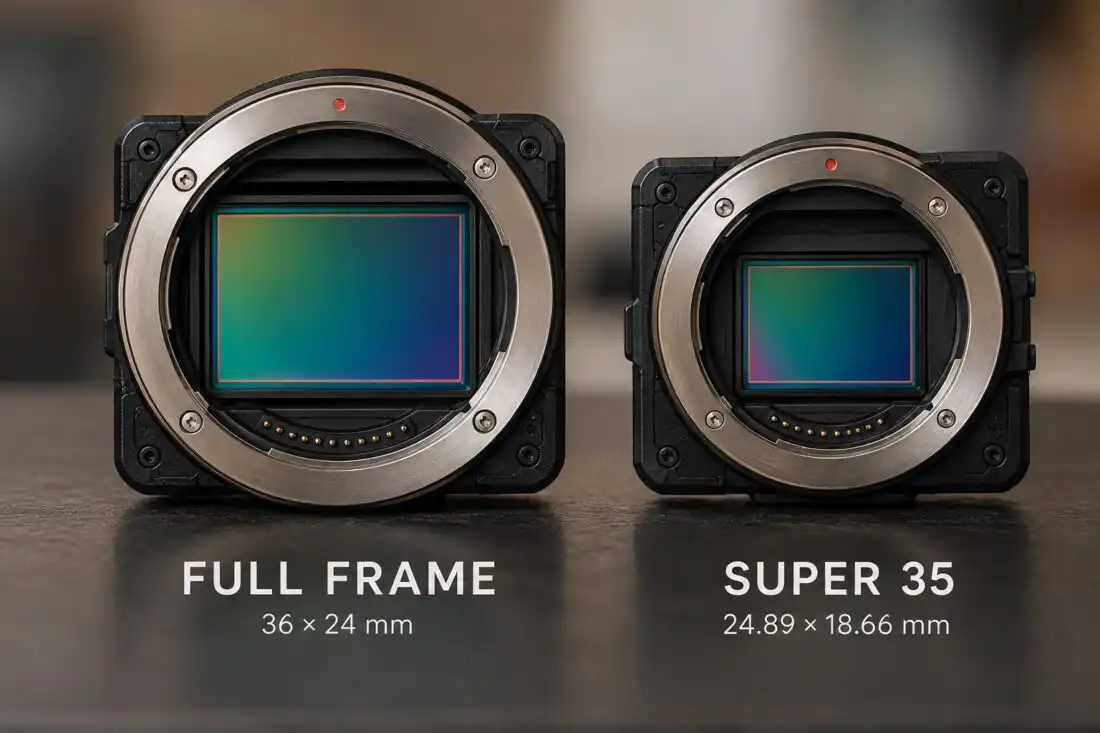
Full-frame cameras are everywhere right now. And if you listen to camera marketing, you might think Super 35 suddenly became a terrible format. It didn’t. So when it comes to full frame vs Super 35, what’s the actual difference?
Super 35 has been used to make some of the most beautiful movies and television you’ve ever seen. The differences between the two formats are real, and they affect how you frame, focus and choose lenses. But neither one is a shortcut to a great image.
Full Frame vs Super 35: What Are We Talking About?
A full-frame sensor is roughly the same image area as a 35mm still-photo frame: approximately 36 × 24mm. The sensor is the part of the camera that captures the image. Its image area is the part that actually records light. Full frame gets its name from that still-photo frame size.
Super 35 is smaller, roughly the size of an APS-C cinema sensor, depending on the exact implementation. APS-C is a sensor size you’ll also find in many still cameras, and it’s smaller than full-frame. Manufacturers size their Super 35 sensors a little differently, so the exact dimensions vary from camera to camera.
The difference affects field of view, depth of field, lens compatibility, and sometimes resolution and low-light performance. Field of view is how much of the scene you see in the frame. Depth of field is how much of the image looks sharp from front to back. Lens compatibility depends on whether a lens can cover the entire sensor.
Resolution and low-light performance only change sometimes, because they depend on how each camera is designed, not just on sensor size. And the difference does not automatically determine image quality. A great image still comes from the whole package, including the lens, the light and the person behind the camera.
Full Frame Gives You a Wider Field of View
The first difference between full-frame and Super 35 is field of view. Put the same lens on a full-frame camera and a Super 35 camera, and the full-frame camera will generally give you a wider field of view. That’s because the smaller Super 35 sensor only records the center of the image the lens creates.
The Super 35 image looks tighter, as if you had cropped in. A 24mm lens feels very wide on full frame, but on Super 35 it gives you a narrower field of view. That wider full-frame view can be useful.
This can matter when you’re shooting in tight interiors, cars, real estate, documentary environments, or anywhere you want a wide perspective without using an extremely wide lens. In a small room or inside a car, you often can’t back the camera up any further. With the same lens, full frame shows more of the space to the right of where you’re standing.
Full Frame Can Also Make Shallow Depth of Field Easier
Depth of field is another full frame vs Super 35 difference. At the same framing and aperture, full-frame can produce a shallower depth of field than Super 35. Shallow depth of field is when your subject is sharp, and the background falls softly out of focus.
The aperture is the opening inside the lens that controls how much light passes through. It also affects how much of the scene stays in focus. Framing matters too: to match the same framing on a full-frame sensor, you use a longer lens or move the camera closer. Both of those make depth of field shallower.
Full Frame Doesn’t Equal Cinematic
But don’t turn this into “Full frame = cinematic.” That’s nonsense.
Super 35 can produce beautiful shallow-focus images. Lighting, lens choice, camera distance and subject distance all matter. Change any one of them, and the look changes with it, whatever the sensor size.
Super 35 Still Has Major Advantages
Super 35 is incredibly well established in cinema. There are many more lenses out there that only cover the Super 35 sensor and not full frame. This means more lens choices when shooting Super 35, and often, more affordable lenses.
Why Lens Coverage Matters
In the full frame vs Super 35 comparison, lens choice is where Super 35 has a clear edge. Every lens projects a circle of image onto the sensor. A lens built for Super 35 makes a circle big enough for that sensor, but not for a full-frame one.
On a full-frame camera in full-frame mode, that lens will usually leave dark corners in the frame. Full-frame lenses, on the other hand, cover a Super 35 sensor too. So when you shoot Super 35, both kinds of lenses are on the table.
Super 35 Isn’t Going Anywhere
The top-of-the-line ARRI ALEXA 35 uses a Super 35 sensor. Canon’s C300 Mark III and C70 are Super 35 cameras too. When a camera at that level is built around Super 35, that tells you a lot about where the format stands. Super 35 isn’t going anywhere.
Some Cameras Give You Both
Some cameras give you both formats in one body. They do it with crop modes, which record from a smaller area in the center of the sensor.
The Canon C500 Mark II has a full-frame sensor but supports Super 35 and Super 16 crop modes. Super 16 is an even smaller format than Super 35. The Canon C80 has full-frame and Super 35 crop modes.
And RED cameras can offer multiple sensor formats depending on the model. The V-RAPTOR 8K VV, for example, provides both large-format and Super 35 recording modes. Large format refers to a sensor area bigger than Super 35.
That flexibility can be extremely useful if you have a varied lens collection. You can switch to a Super 35 mode for lenses that only cover Super 35. Then you can go back to the full sensor for your full-frame lenses, all without changing cameras.
Full Frame vs Super 35: Which Is Better?
Neither. Each format has real strengths, and the right one depends on the shoot and the lenses you want to use.
When Full Frame Makes Sense
If you need wide perspectives, shallow depth of field, or want to take advantage of full-frame lenses, full frame can be fantastic. Tight interiors and cars are good examples, since a wider field of view helps when you can’t step back. It’s also a natural fit when you want shallow focus to come a little easier.
When Super 35 Makes Sense
If you love the traditional cinema look or have a large S35 lens collection, there’s absolutely nothing wrong with Super 35. The same goes if you want more apparent reach from your lenses, or simply prefer the way an S35 camera renders.
Apparent reach comes from that tighter field of view. On Super 35, a lens frames your subject closer, as if you were using a longer lens. That helps when you can’t get physically close to what you’re filming.
A Great DP Can Work With Either
Personally, I think the industry has gotten a little obsessed with sensor size. A great DP can make a beautiful image on either. The DP, or director of photography, is the person responsible for the look of the image. That skill carries over to any sensor size.
And if someone tells you a Super 35 camera can’t produce a cinematic image… show them an ARRI ALEXA 35. Then enjoy the silence.
Let’s Make Something
If you’re weighing cameras for an upcoming shoot, we’re happy to talk it through. We know the equipment we rent because we actually use it, and our camera and equipment rentals are prepped and ready to go before every rental. Need an operator or an assistant with the camera? We can provide experienced production crew, or handle the whole job through our video production team.
Whether your project needs creative development before the cameras roll or a single piece of gear on shoot day, our production services are built around your project, and our portfolio covers documentary, commercial, and branded work. As a small, owner-led production company, we give you one point of contact from start to finish. Tell us about your shoot, get a quote or call 954-249-0702.