
Tokina Vista Prime Review: My Favorite Affordable Cinema Primes?
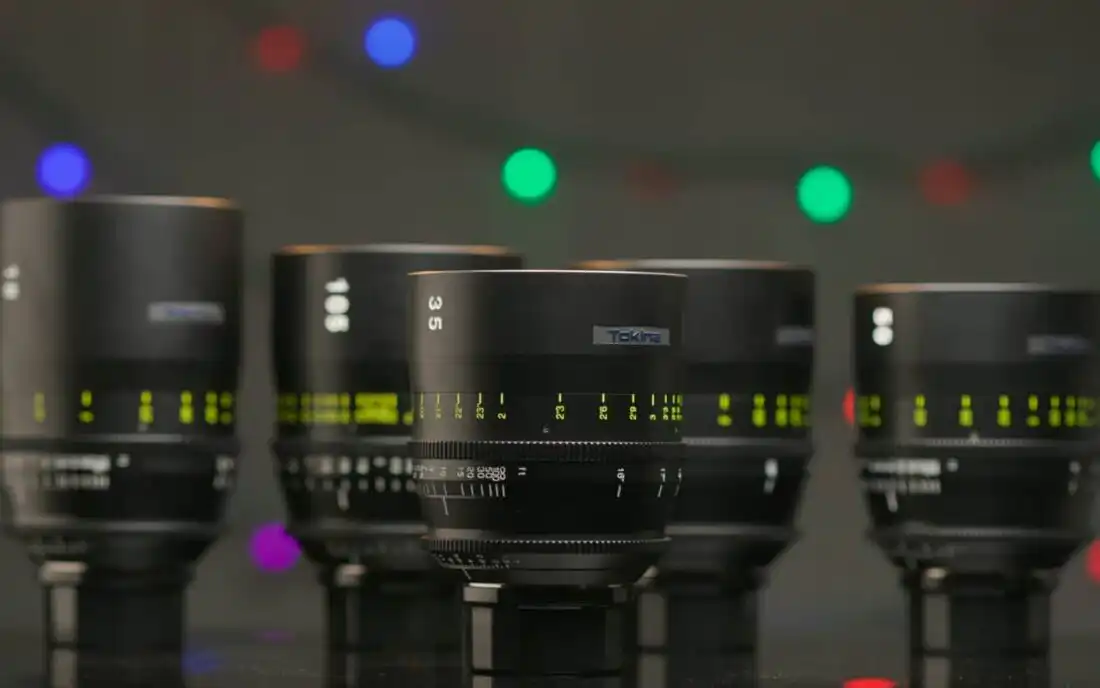
There are a lot of cinema primes out there. Some cost a few thousand dollars, some cost tens of thousands, and some cost approximately the same as a moderately nice house. So where does that leave filmmakers who want serious cinema glass without completely destroying the budget? That’s the question this Tokina Vista Prime review sets out to answer, and it’s exactly where the Tokina Cinema Vista Primes come in.
And I’ll say it right up front: these are probably my favorite “affordable” cinema primes. Not because they’re perfect, but because they give you a lot of lens for the money.
What Are the Tokina Vista Primes?
The Vista Primes are a modern cinema prime series designed around large-format coverage. A prime lens has a fixed focal length, so instead of zooming, you choose the right lens for each shot. A cinema prime series gives you a set of those lenses made to work together.
A 46.7mm Image Circle for Large-Format Coverage
The standard Tokina Vista Primes feature a massive 46.7mm image circle, which allows them to cover full-frame and VistaVision formats, along with many other large-format sensors. The image circle is the round image a lens projects behind it. To cover a camera’s sensor, that circle has to be big enough to reach every corner of the frame.
They’re available in focal lengths ranging from ultra-wide 18mm all the way up to 180mm, depending on the specific set. That means you can go from a very wide view of a scene at one end to a tight frame from a distance at the other.
Fast Glass With Proper Cinema Mechanics
They’re also fast, with T1.5 across most of the series (the 180mm is T1.9). A fast lens lets in a lot of light, and a T-stop tells you how much light actually makes it through the glass. The lower the number, the more light you get.
That’s a very useful combination: large-format coverage, T1.5, proper cinema mechanics and reasonable pricing. It’s why the Tokina Vista Primes have become such an interesting option for independent productions.
You’ve got proper geared focus and iris rings, approximately 300° of focus rotation, consistent gear positioning and a robust all-metal housing. Geared rings let a follow focus or a lens motor drive focus and iris precisely. A long focus rotation spreads the focus scale out, which makes small focus adjustments easier to control.
Consistent gear positioning means the gears sit in the same place from lens to lens. So when you swap lenses, accessories like a follow focus line up in the same spot, and you get back to shooting faster.
Tokina also designed them for extremely low focus breathing. Focus breathing is when the framing shifts slightly as you change focus, almost like a tiny zoom. With breathing kept that low, you can pull focus from one subject to another without the frame noticeably changing size.
Sharp, but Not Sterile
Optically, they’re very sharp. But they’re not sterile in the way some ultra-clinical modern lenses can feel. And that’s important.
Sharpness is only one part of a great image. I want my lenses to give me a beautiful image, not just a technically perfect one.
T1.5 Is a Big Deal
A T1.5 maximum aperture gives you a lot of flexibility. Obviously, opening up to T1.5 isn’t always what you want. Sometimes you need more depth of field.
Depth of field is how much of the scene, from front to back, looks sharp. Opening the aperture wide makes that zone shallower, which is how you get a subject in focus against a soft background. Closing the aperture down deepens the zone, which helps when more of the frame has to stay sharp.
But when you’re shooting in low light or trying to isolate a subject, having that extra light available is extremely useful. In a dim location, a faster lens lets more light reach the sensor. And when you want your subject to stand apart from the background, opening up gives you that shallow depth of field.
A Matched Series
And because Tokina designed these lenses as a matched series, you can move between focal lengths without completely changing the visual language of the image. Here, visual language means the overall look the lenses give your footage, from color to contrast. With a matched set, a wide shot and a close-up cut together like they belong to the same film. That’s exactly what you want from a cinema lens set.
They’re Big and a Bit Heavy
Let’s be honest: these aren’t tiny lenses. The Tokina Vista Primes have a 114mm front diameter and are substantial pieces of glass. The 25mm, for example, weighs roughly 4.8 to 5.2 lbs depending on mount.
So if your idea of a lightweight camera package is an FX3 with a small zoom lens, maybe don’t put a full set of Vistas in your backpack. A setup like that is all about staying small and light, and these lenses belong on a different kind of rig.
But on a proper cinema build? They make a lot of sense. On a camera that’s rigged and supported for serious glass, their size and weight fit right in.
Why I Like Them
For me, the biggest selling point is the combination of image quality, speed, large-format coverage, cinema mechanics and price. It’s not one feature that wins me over. It’s getting all of them in the same set of lenses.
You can build a serious prime package without immediately jumping into the price category of the really high-end cinema glass. That matters, because a prime package means several lenses, not just one.
Made to Work With a Huge Variety of Cameras
And they’re useful across a surprisingly wide range of cameras. That’s important for a rental house, because we don’t know what camera a client is going to bring. Will it be Sony, Canon, RED or ARRI?
The Tokina Vista Primes are designed to play nicely with a huge variety of large-format cinema cameras. For us, that means one set of primes can serve a lot of different productions.
Who Should Rent Tokina Vista Prime Lenses?
I’d especially recommend the Vistas for narrative films, commercials, music videos and short films. They’re also a great fit for documentary interviews and for corporate films where you want a more cinematic look. And they make a lot of sense for productions shooting full-frame or large-format cameras, which is exactly the coverage Tokina designed the series around.
If you have a little more time to compose your shots and want that classic prime-lens workflow, they’re fantastic. With primes, you pick the focal length for each shot and build the frame around it. That more deliberate approach suits productions that have the time for it.
And if you’re coming from still photography lenses and want to experience what proper cinema primes feel like? Even better. The Vistas are a great way to get hands-on with the cinema mechanics I covered above.
My Verdict
There are certainly more expensive lenses. There are certainly more exotic lenses. And there are lenses with more distinctive vintage character.
But if someone asked me, “What cinema primes would you recommend for a serious production without spending a fortune?” the Tokina Vistas would be very high on my list. They’re fast, sharp, robust, large-format capable and genuinely built for cinema.
And most importantly, I actually like shooting with them. That’s probably the best review I can give.
Let’s Make Something
We use the lenses and cameras we rent on real productions, so we can help you choose what your shoot actually needs, and just as importantly, what it doesn’t. Our camera and lens rentals are available individually or packaged around your shoot, and we can add experienced DPs, camera operators and ACs when you need people as well as glass. For a team that takes the project from planning through post, our video production services cover that too.
From developing the look before you shoot to the final frame, our production services are built around your project, and our work spans documentaries, commercials and branded content. Agape Media Group is a small, owner-led production company based in South Florida, so you work directly with the people responsible for your project. Tell us what you’re shooting, request a quote or call 954-249-0702, and we’ll help you put the right lens package together.