
Sony FX3 vs FX6 vs FX9: Which Sony Cinema Camera Is Right for You?
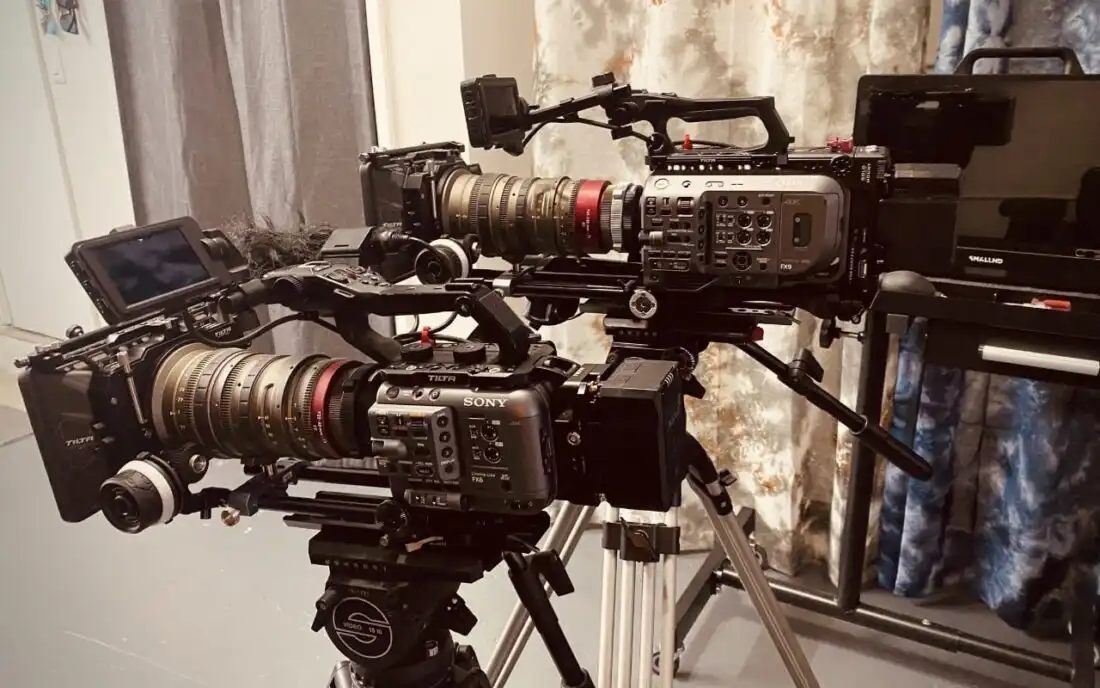
Sony’s FX lineup has become one of the most interesting camera families in professional video. Line up the Sony FX3 vs FX6 vs FX9, and the first difference you notice is size.
The FX3 is tiny. The FX6 is tiny-ish. And the FX9 is… well, now we’re getting into serious production-camera territory.
All three can produce beautiful images, but they’re designed for very different jobs. So the right choice comes down to what your shoot actually needs.
Sony FX3: Tiny Camera, Serious Image
The FX3 is essentially a professional video camera packed into an extremely small body. It uses a full-frame sensor and can record 4K up to 120p. It also supports 10-bit 4:2:2 recording in several internal formats.
In plain terms, 4K up to 120p means the camera can capture as many as 120 frames every second. Played back at a normal speed, that becomes smooth slow motion.
The 10-bit part is bit depth, or how many fine steps of tone and color the file can hold. The 4:2:2 part describes how much color information the file keeps, and it holds more than lighter formats do. Together, they give you more room to work when you color grade.
Where the FX3’s Small Size Pays Off
It’s incredibly useful when size matters. Think gimbal work, small crews, travel, documentary, car rigs, tight spaces, behind-the-scenes and low-budget multicam setups.
A lighter camera is easier to balance and carry on a gimbal, and it’s easier for a small crew to manage. It also packs down for travel. On a documentary, it can move with the story without taking over the room.
The same goes for car rigs and tight spaces, where a bigger body may not fit or mount easily. A behind-the-scenes shooter can work alongside the main production without getting in the way. And for low-budget multicam setups, it gives you another professional angle in a very small package.
The Catch: No Built-In ND Filter
But there’s a catch. The FX3 does not have a built-in electronic ND filter, and that matters to me for documentary and “run and gun” shooting environments.
An ND filter, short for neutral density, cuts down the light coming through the lens without changing its color. That matters because your other exposure tools do more than set brightness. Shutter speed shapes how motion looks, and aperture shapes how much of the frame is in focus. So you often don’t want to change either one just to handle bright light.
If you’re shooting outdoors, you may want to maintain your shutter speed and aperture while controlling exposure. In that case, you’re going to need external ND filtration. That means physical filters in front of the lens that you add or swap as the light changes. In a run-and-gun environment, where you’re moving fast and reacting to what happens, every filter change costs time.
The FX3 also isn’t built around the same physical production ergonomics as the FX6 or FX9. Ergonomics is how a camera handles in real use, from how you hold it to where the controls sit. It’s an amazing little camera, but it’s still little.
Sony FX6: The Sweet Spot
The FX6 is where things get really interesting. You get a full-frame sensor, 15+ stops of latitude, excellent autofocus, dual-base sensitivity, a built-in electronic variable ND filter and 4K 120p.
Latitude is the range of light, from deep shadows to bright highlights, that the camera can capture with detail, and it’s measured in stops. More stops means a bright sky and a dark interior are more likely to keep their detail in the same shot. Dual-base sensitivity gives the camera two native ISO settings, one for normal light and a higher one for darker scenes.
Why the FX6 Became Such a Popular Production Camera
This is why the FX6 has become such a popular production camera. It’s small enough to move quickly but professional enough to build into a serious production package.
A production package is the camera plus everything a professional shoot builds around it, such as monitors, power and support. With the FX6, you can keep things lean when you need to move, then build it out when the job calls for more.
For documentary work, commercial production, interviews, corporate work, branded content and run-and-gun shooting, it’s hard to argue with. Those are very different kinds of shoots, and the FX6’s mix of size and professional features covers all of them well.
Built-In Variable ND, Especially in Florida
The built-in variable ND is one of my favorite features, especially in Florida. Instead of swapping filters, you dial in the amount of ND you need right inside the camera. Under bright sun, that makes it much easier to keep your shutter speed and aperture exactly where you want them.
Sony FX9: The Production Workhorse
The FX9 is a different philosophy. Sony gives it a full-frame 6K sensor that oversamples to 4K, along with dual base ISO. It can also operate in Super 35 while retaining 4K recording, which the FX6 can’t.
Oversampling means the camera captures more resolution than the final 4K file needs and then scales it down. That tends to give you a cleaner, more detailed image. Super 35 is a smaller recording area based on a classic motion picture film format. It’s useful with lenses designed to cover that smaller area.
Sony also designed it around more traditional shoulder-style operation, and you can expand it with Sony’s XDCA-FX9 unit. That makes it much more attractive for larger productions, reality shows, broadcast-style work, multicamera production and long-form shooting.
Shoulder-style operation means the camera rests on your shoulder rather than sitting out in front of you in your hands. Your shoulder carries much of the weight instead of your arms, which matters when the camera stays up for long stretches.
It’s a bigger camera. But sometimes bigger is better, especially when you’re holding it for hours.
Sony FX3 vs FX6 vs FX9: Which One Should You Rent?
When it comes to the Sony FX3 vs FX6 vs FX9, the right rental depends on the job in front of you. Here’s when I’d reach for each one.
Choose the FX3 When Size Comes First
Choose the FX3 if you need the smallest possible professional package. It’s also the pick if you’re using a gimbal or traveling.
The FX3 makes sense, too, if you need a B or C camera that can match the Sony ecosystem. A B or C camera is a second or third angle running alongside your main camera. Matching the Sony ecosystem means it fits in with the other Sony cameras on the job instead of being the odd one out.
Choose the FX6 for the Best Mix of Size and Features
Choose the FX6 if you want the best combination of size and professional functionality. It’s the right call when you need built-in ND, when you shoot documentaries or run-and-gun, or when you need 4K 120p.
It’s also the one if you want excellent autofocus. And if you want a camera that’s easy to build into a serious package, the FX6 checks that box as well.
Choose the FX9 for Long-Form and Broadcast Work
Choose the FX9 if you’re shooting longer-form productions or you want a more traditional shoulder-mounted configuration. It’s also the pick if you need greater production connectivity, or if you’re working in broadcast or multicamera environments.
Connectivity is about how the camera connects to the rest of the production and the other equipment on set. Finally, choose the FX9 if you want the additional flexibility of a 6K sensor and S35 4K operation.
My Pick for Most Independent Productions
In the Sony FX3 vs FX6 vs FX9 debate, my pick for most independent productions is the FX6. It’s the Goldilocks. The FX3 is smaller and the FX9 is more production-oriented, but the FX6 hits an incredibly useful middle ground.
In Goldilocks terms, it’s not too small and not too big. You get the professional features and the room to build it out without carrying more camera than you need. And that’s why it’s one of the cameras we carry.
That’s the Whole Point of Renting
That doesn’t mean it’s the right camera for every shoot. That’s the whole point of renting. Instead of forcing one camera to cover every job, you pick the one that fits the production in front of you.
That might mean the FX3 on a gimbal or in a car rig, the FX6 for a run-and-gun documentary day, or the FX9 for long-form broadcast work. Sometimes you need the little one. Sometimes you need the big one. And sometimes you need all three!
Let’s Make Something
If you’re weighing cameras for an upcoming shoot, we’re happy to talk it through. We know the equipment we rent because we actually use it, and our camera and equipment rentals are prepped and ready to go before every rental. Need an operator or an assistant with the camera? We can provide experienced production crew, or handle the whole job through our video production team.
Whether your project needs creative development before the cameras roll or a single piece of gear on shoot day, our production services are built around your project, and our portfolio covers documentary, commercial and branded work. As a small, owner-led production company, we give you one point of contact from start to finish. Tell us about your shoot, get a quote or call 954-249-0702.