
Virtual Production Is Changing Filmmaking. But Is an LED Wall Really the Answer?
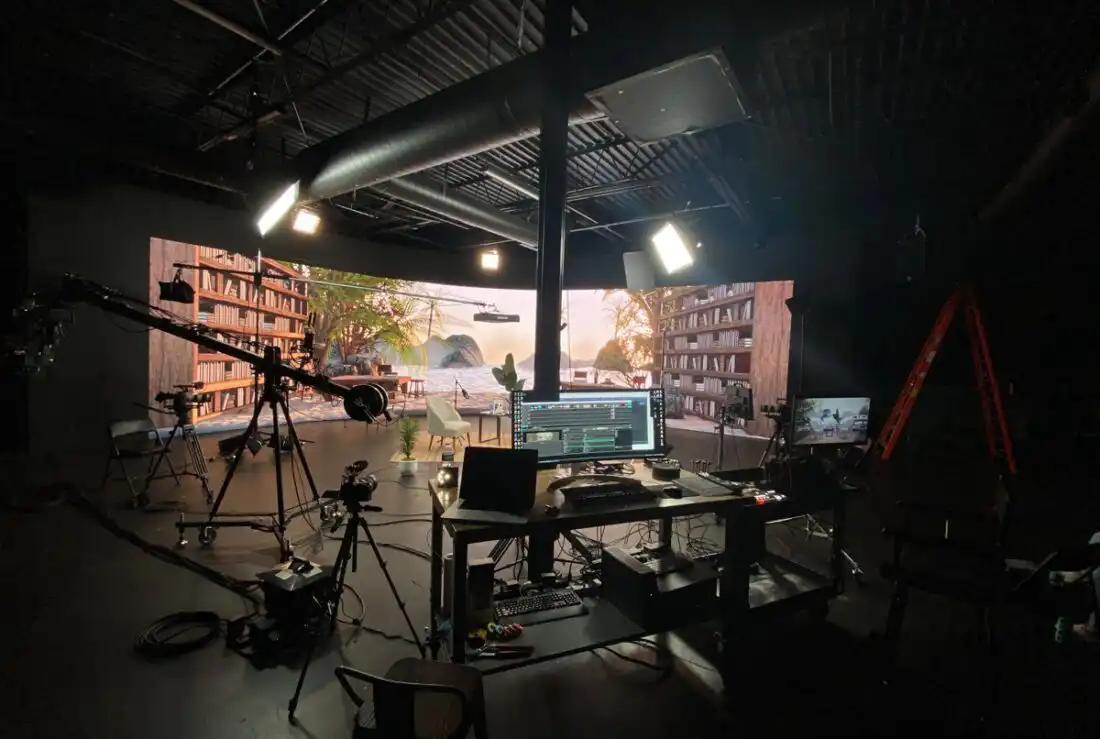
From Hollywood to South Florida: What filmmakers and producers should know before booking a virtual production studio.
Imagine filming a sunset scene at 10 a.m., resetting it for another take at 2 p.m., and never checking the weather. Welcome to virtual production—where the scenery can be digital, but the production problems are still very real.
LED-volume filmmaking has become one of the most talked-about tools in film and commercial production. It can be remarkable. It can also be an expensive way to discover that your camera, LED wall, and background content don’t get along. I’ve worked as a cinematographer and camera operator in broadcast and production environments, including on a virtual production stage. My advice: understand the workflow before falling in love with the wall.
First, what exactly is virtual production?
Virtual production (VP) is broader than LED walls. It includes previs, virtual scouting, motion capture, real-time graphics, and other workflows that blend physical filmmaking with digital environments. Most people picture in-camera visual effects (ICVFX): actors and real props are photographed in front of large LED displays showing a digital environment.
Unlike a traditional green screen, the crew and performers can see the background during filming. The LEDs can also contribute real reflections and ambient light. On more sophisticated stages, camera tracking tells a real-time engine, often Unreal Engine, how the camera moves so the background perspective changes naturally. That’s parallax, and it’s a big part of the illusion.
Fun fact: the concept isn’t entirely new. Filmmakers were using projected driving backgrounds decades before anyone said ‘Unreal Engine.’ Modern LED walls are a much more flexible descendant of rear projection, not a magical invention from another planet.
Why did virtual production studios take off?
Productions want more control over location, weather, time of day, travel, and continuity. Better real-time graphics, faster computers, improved LED processing, and increasingly accessible panels have helped bring VP beyond giant film franchises. Smaller LED stages can now make sense for interviews, music videos, product spots, commercials, and controlled car interiors.
But ‘more affordable LED walls’ doesn’t mean ‘cheap virtual production.’ Camera tracking, media servers, calibration, color management, power, rigging, trained operators, and content creation still cost money. A budget-friendly wall can be excellent for a locked-off background and entirely wrong for a moving, photorealistic wide shot.
Is the industry still growing? Market researchers continue to forecast growth: Grand View Research estimated the global virtual production market at about $3.3 billion in 2026, with significant expansion projected through 2033. Those are forecasts for the broader VP market—not a guarantee that every LED stage will stay busy or profitable. The technology is maturing, and clients are getting more selective about where it genuinely saves time or improves the image.
How many virtual production studios are in Florida?
There isn’t a reliable, comprehensive public census of rentable LED-volume stages in Florida. Studios open, change ownership, and advertise different capabilities. Some are private facilities or educational stages. So an exact statewide number would be misleading.
As of October 2026, I could identify at least seven publicly described Florida LED-stage facilities or operations worth investigating, including at least three in South Florida. Examples include Robots Studios in Miami; BrandStar’s Pompano Beach LED volume; Studio 70 in West Palm Beach; Vū in Tampa; Litewave Studios in St. Petersburg; The Vault in Jacksonville; and Viera Studios in the Orlando/Winter Garden area. This is a researched minimum of examples, not a verified inventory of all bookable stages. Confirm availability, current specifications, and whether similarly marketed spaces are separate facilities before planning a shoot.
For South Florida productions, that means Miami-Dade, Broward, and Palm Beach counties have real options without automatically flying the crew to Los Angeles. Florida’s weather is lovely, until your exterior shoot hits a 3 p.m. thunderstorm. A controlled stage has obvious appeal.
Pixel pitch: the tiny measurement that can ruin a big shot
If you remember one LED-wall specification, make it pixel pitch. Pixel pitch is the center-to-center distance between neighboring LED pixels, measured in millimeters. Smaller numbers mean the pixels are packed more tightly. A 1.9 mm wall is finer than a 2.6 mm wall, which is finer than a 3.9 mm wall.
Why care? Because your camera may resolve the LED pattern, producing visible pixels or moiré—those distracting ripples and patterns that make a beautiful background look like a bad shirt on television. Fine pitch can help, especially when the camera or subject is close to the wall. But pitch alone doesn’t guarantee a clean image: sensor sampling, lens choice, aperture, focus, framing, wall distance, and image processing all matter.
A wide shot with the wall softly out of focus may work beautifully on a coarser-pitch stage. A sharp close-up of a detailed digital cityscape may demand much finer pitch, more distance, or a different approach. Ask for the wall’s actual pixel pitch, not just ‘it’s a 4K wall.’ And always test your real camera and lenses on the actual stage.
Frame rate, refresh rate, genlock—and the dreaded rolling bands
Camera frame rate and LED refresh rate aren’t the same thing. Your camera might record 23.976, 24, 25, 29.97, or 30 frames per second. The LED panel’s advertised refresh rate may be thousands of hertz, describing how the display is driven. The LED processor also has an input/output frame timing. These systems must play nicely together.
When they don’t, you can see flicker, horizontal bands, partial frames, or strange artifacts that weren’t obvious on set. Genlock and appropriate synchronization/phase settings can align the camera and display system. A high refresh-rate spec helps, but it’s no substitute for proper synchronization, processor configuration, and a camera test.
For standard-speed shooting, establish the camera frame rate, shutter angle, wall output rate, and sync strategy before the day. For high-frame-rate work, ask the studio specifically whether that combination has been tested. ‘We’ll fix it in post’ is not a production plan. It’s a prayer.
Does a global shutter camera solve everything?
No—but it can help. A global shutter exposes the sensor all at once rather than reading it line by line, which can reduce rolling-shutter artifacts and skew. That’s useful around displays and fast motion. However, a global shutter does not eliminate moiré, incorrect color, poorly timed LED processing, or bad backgrounds. Rolling-shutter cameras can also work extremely well on LED stages when the pipeline is properly synchronized. Let testing and the desired image drive camera choice, not a single spec on a sales sheet.
The cinematographer matters more, not less
A virtual environment doesn’t light itself into a believable shot. The DP still has to shape faces, control contrast, select lenses, manage reflections, match color temperature, and make foreground and background feel like one place. In fact, the LED wall adds new variables: wall brightness and color, spill on skin, black levels, moiré, depth of field, camera-to-wall distance, and the relationship between practical lights and digital light sources. Just as important are practical foreground elements: real furniture, architectural pieces, plants, props, and carefully designed set dressing give the camera believable depth, texture, and interaction with light. A great art department and set designer work closely with the DP to blend those physical elements into the virtual background. Without that teamwork, even a stunning LED environment can feel like actors standing in front of a giant television.
An experienced VP cinematographer knows when to ask for a background adjustment instead of fighting the image with another fixture. They also know when to push back on a technically possible shot that won’t look convincing. Bring the DP into planning early, before you consider the digital environment finished. A pretty Unreal scene isn’t automatically a photographable set.
The extra crew positions you may need
Traditional camera, grip, electric, sound, production, and art departments still matter. Depending on complexity, VP introduces specialists who may be unfamiliar to smaller productions:
- Virtual production supervisor: coordinates the creative and technical VP workflow, often across prep, stage, and post.
- Unreal Engine operator / real-time artist: loads, adjusts, and renders the digital environment during filming.
- LED engineer / wall technician: manages panels, processors, mapping, calibration, and display troubleshooting.
- Camera-tracking technician: calibrates tracking systems and ensures camera and lens data line up with the virtual world.
- Playback / media-server operator: prepares and runs video plates, stills, and mapped content for the wall.
- Color scientist / DIT: helps maintain a consistent viewing, camera, and display color pipeline.
One skilled person may cover multiple jobs on a simple plate-based shoot. A complex tracked volume may need a dedicated ‘brain bar’ team. The key is assigning responsibility before something breaks, not during the first take.
Unreal Engine or real high-resolution backplates?
This is one of the biggest creative decisions, and neither answer is universally better.
Unreal Engine environments are powerful when you need interactive camera movement, controllable lighting, changing perspective, or a location that doesn’t exist. But creating convincing environments requires serious artistic work: modeling, textures, lighting, optimization, and testing. Real-time rendering isn’t automatically photorealistic.
High-resolution photographic or video backplates can be a fantastic option for locked-off or carefully controlled shots, natural landscapes, windows, and some vehicle interiors. Real footage has authentic textures, motion, and atmospheric detail. But a flat 2D plate won’t generate correct perspective shifts when the camera moves freely. For driving scenes, matched multi-camera driving plates or 360-degree environments may be necessary.
And resolution matters. A background that looks sharp on your laptop may look soft when spread across a massive wall. Ask about the LED canvas resolution, crop, playback format, frame rate, and whether the footage can loop cleanly. High pixel count doesn’t rescue a badly chosen plate.
For natural-background footage in unusually high resolutions, our sister resource, StockPlates.com, offers stock clips suitable for consideration as background plates. We don’t currently offer driving-plate packages or 360-degree environments; specialized vendors do. Whatever source you use, license the content correctly and test it on the wall before shoot day.
A practical checklist before booking an LED volume
- Define the shot: locked camera, modest movement, or fully tracked moving camera?
- Request the stage dimensions, wall shape, pixel pitch, pixel resolution, refresh specifications, and camera-to-wall working distance.
- Ask whether the stage supports your frame rate, shutter settings, genlock, and planned cameras.
- Confirm what camera tracking, lens calibration, Unreal/media-server support, and operators are included.
- Review background plates or virtual environments at full quality—not just a compressed preview.
- Test skin tones, dark scenes, reflections, moiré, and flicker with your actual lens and framing.
- Budget for content preparation, prelight, calibration, tech rehearsal, and contingency time.
- Decide who owns the digital assets and what post-production cleanup may still be needed.
When should you skip virtual production?
If you already have access to the real location, have a very small budget, need lots of spontaneous camera movement, or don’t have time to prep content and test, a conventional shoot may be simpler and better. Virtual production is a tool, not a badge of sophistication. Sometimes the smartest production decision is to go outside and film the actual tree.
The bottom line for Florida filmmakers
Virtual production is no longer reserved for the biggest studios, and Florida has a growing range of places to explore it. But successful VP is less about renting an LED wall and more about building a complete imaging workflow around the story. The right cinematographer, the right technical crew, the right background, and a proper test day can make the difference between believable movie magic and an expensive screensaver.
At Agape Media Group, we don’t operate our own virtual production stage, but we bring real-world cinematography, broadcast, and on-stage VP experience to productions that need thoughtful camera and lighting support. If you’re considering a virtual production shoot in Miami, Fort Lauderdale, West Palm Beach, or elsewhere in Florida, we’d be happy to discuss the approach, crew, and equipment that make sense for your project.
Natural-background plates: StockPlates.com